
The American Revolution
The American Experiment ~ Jeffrey Goldberg

POLITY - a voice for action is written as a service to you, the fierce, courageous people ~ all of us ~ who are the front line of defense for the democracy we love.
We give flight to the most impactful voices of our time ~ that we might all be encouraged to take action.
“Society is produced by our wants, and government by our wickedness; the former promotes our happiness positively by uniting our affections, the latter negatively by restraining our vices. The one encourages [social] intercourse, the other creates distinctions. The first is a patron, the last a punisher.”
Thomas Paine, Common Sense, 1776
The American Revolution
I’m ever more inspired to use my voice when I read about our founders’ foresight, defiance, sacrifice and demand for independence.
The Atlantic’s November magazine cover inspired me to encapsulate the stories The Atlantic tells. The cover image commemorates the 250th anniversary of the American Revolution.
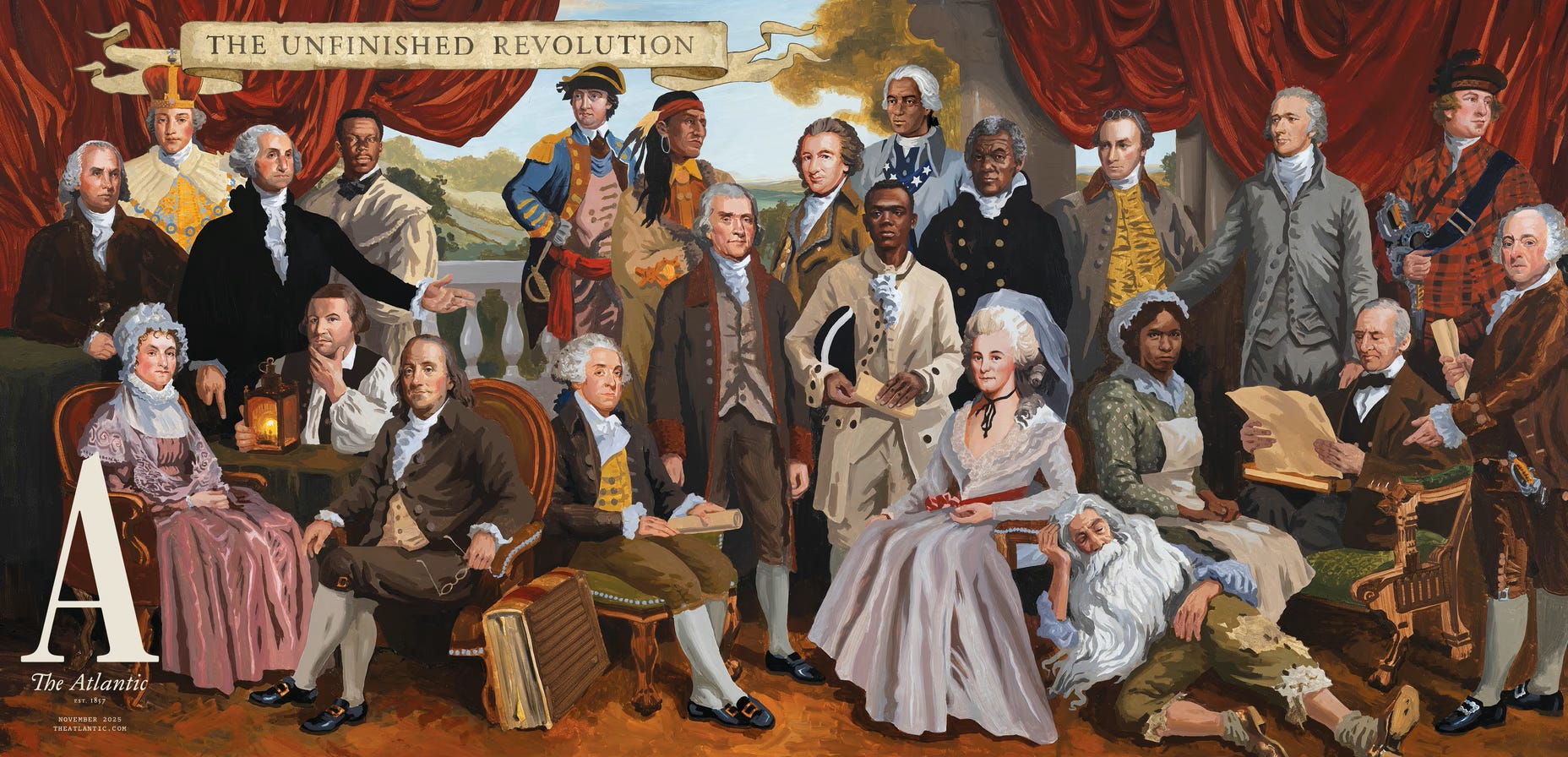
The cover is a painted tableau of 23 figures whose stories represent the Revolution: some, recognizable historical figures like Thomas Jefferson and Benjamin Franklin, and some as depictions based on historical portraiture, such as Paul Revere, the heroic silversmith.
Beside George Washington in the painting is Harry Washington, a man he enslaved. Like many other enslaved people, Harry Washington abandoned the plantation at the onset of the war to fight for Great Britain.
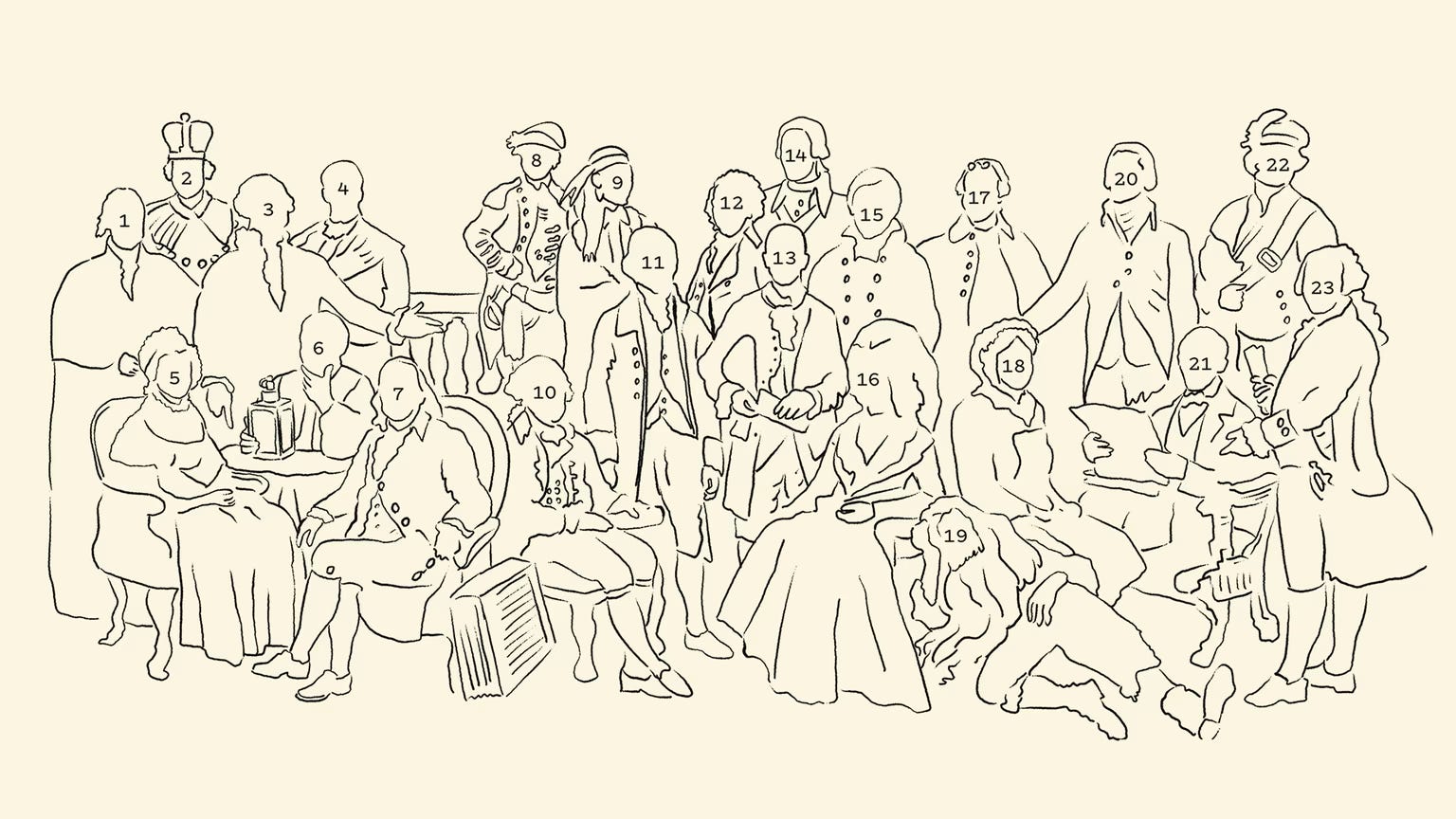
Depicted are:
James Madison
King George III
George Washington
Harry Washington
Abigail Adams
Paul Revere
Benjamin Franklin
Benedict Arnold
Pontiac
William Franklin
Thomas Jefferson
Thomas Paine
Robert Hemmings
Prince Hall
James Armistead Lafayette
Eliza Schuyler
Patrick Henry
Priscilla Timbers
Ripe Van Winkle
Alexander Hamilton
Ralph Waldo Emerson
Lord Dunmore, and
John Adams.
Even King George III is included in the tableau, though he represents a different side in the war.
The Atlantic’s writers and editors “recognize that the American experiment is under extraordinary pressure at the moment, and we think it important to do anything we can to illuminate the challenges we face.”
These articles are divided into five chapters: Defiance, Conflict, Independence, Memory and Crisis.
I’ll be distilling numerous of these articles so we may all have a deeper, clearer understanding of the ‘shoulders’ upon which our democracy stands.
The Lead
Editor-in-Chief, Jeffrey Goldberg, leads with an article entitled, “The American Experiment,” where he quotes Thomas Paine’s remarks in 1775 in the first issue of The Pennsylvania Magazine.
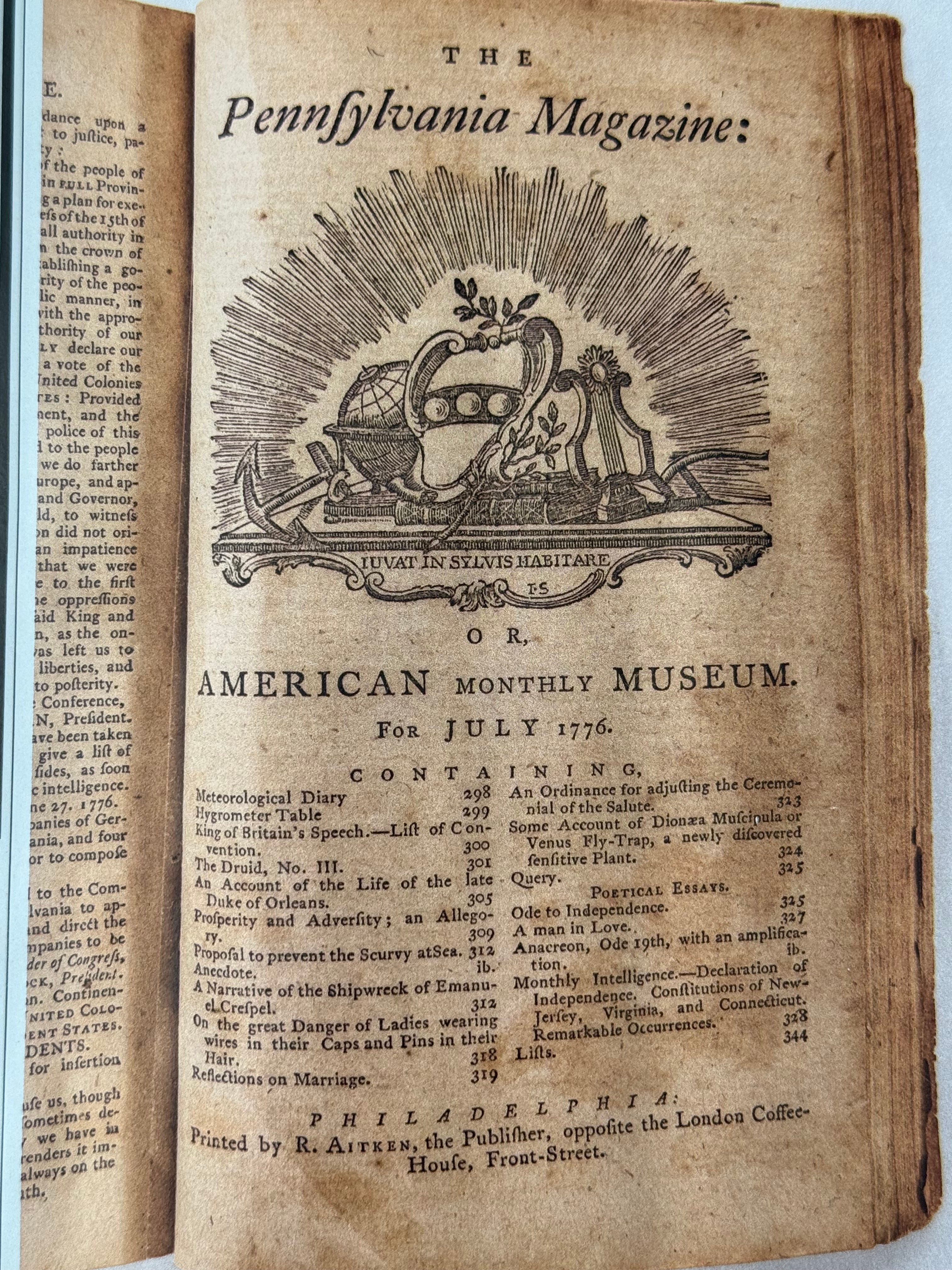
Thomas Paine: “A magazine, when properly conducted, is the nursery of genius; and by constantly accumulating new matter, becomes a kind of market for wit and utility.”
Paine served as editor of the magazine until his cheapskate boss refused to give him a raise, at which point he resigned to devote himself to Common Sense, the 47-page pamphlet advocating independence from Great Britain for the 13 colonies.
Jeffrey Goldberg: “Hidden near the back of the magazine we find a set of documents collected under the rubric “Monthly Intelligence.” These documents include the newly written constitutions of Virginia, Connecticut and Jew Jersey, as well as… The Declaration of Independence,” its secondary position in the magazine oddly in accordance with the editing protocols of the day.
“The Atlantic in your hands does not make the mistake of downplaying the Declaration, or the events of 1776. You will see that we are not simplistic, jingoistic, or uncritical in our approach, but we are indeed motivated by the idea that the American Revolution represents one of the most important events in the history of the planet, and its ideals continue to symbolize hope and freedom for humankind.
“We also recognize that the American experiment is under extraordinary pressure at the moment, and we think it important to do anything we can to illuminate the challenges we face.”
In closing his introductory essay, Goldberg gives snapshots of the illumination the magazine’s contributors offer, ending with this:
Goldberg: “… Jack Lundberg, The Atlantic’s in-house historian and archivist, writes about Lincoln and the way in which he called upon the spirit of 1776 to remind his fellow Americans of the work still before them. “As the nation fractured, Lincoln summoned the Revolution as neither empty hypocrisy nor mindless triumph,” Lundberg writes, “but as an unfinished project whose noblest values could redeem the past and heal the present.”
“The project is still unfinished, and troubled, but it remains a project worth pursuing.
“That is the argument of this issue.”
Thomas Paine: “The sun never shined on a cause of greater worth. ’Tis not the affair of a city, a county, a province, or a kingdom, but of a continent—of at least one eighth part of the habitable globe. ’Tis not the concern of a day, a year, or an age; posterity are virtually involved in the contest, and will be more or less affected, even to the end of time, by the proceedings now. Now is the seed time of continental union, faith and honor. The least fracture now will be like a name engraved with the point of a pin on the tender rind of a young oak; the wound will enlarge with the tree, and posterity read it in full grown characters.
Travel with me through short, upcoming posts to better understand the complexity and brilliance of the greatest human experiment of all time.
Comments are genuinely appreciated.
If you enjoy this newsletter, please click on the ❤️ icon to like the post. This one gesture tells the algorithm our work is worth supporting.